Enabling ISO20022 for Syndicated Loan Amendments
Research Papers
David Baxter






Executive Summary
Syndicated loan amendments remain among the most opaque and manual workflows in capital markets. While corporate actions benefit from ISO-standardised messaging, loan amendments depend on emails, PDFs, and/or proprietary portals, which obstruct automation and transparency.
This paper advocates for industry adoption of an ISO 20022-aligned message format to support syndicated loan amendment events. Using real-world examples, we explore how a structured event message could be constructed and integrated into straight-through processing (STP) environments.
Why Standardise Loan Amendments?
Operational Risk: Manual interpretation of agent notices increases risk of missed elections or inaccurate instructions.
Lack of Interoperability: Proprietary formats across the ecosystem can limit downstream processing and integration.
Regulatory & Investor Pressure: Buy-side firms, custodians, and regulators increasingly expect structured, auditable events.
ISO 20022 Adoption: With payments, securities, and corporate actions moving to ISO 20022, loan events remain a major gap.
Why This Hasn't Happened Yet
Despite wide acknowledgment of the problem:
Existing platforms and service providers have evolved around proprietary data models and workflows, which can make standardisation across the ecosystem more complex.
Loan agents continue to act as central coordinators of amendment activity, often distributing information through formats that are not easily standardised.
Buy-side operations teams have historically focused on adapting to existing processes rather than reshaping them collectively.
Unlike other asset classes, there is no formally established market practice framework specifically defining structured messaging for syndicated loan amendments, although industry bodies such as the LMA, LSTA, and APLMA play important roles in broader market coordination.
This combination of structural, operational, and governance factors has contributed to the persistence of manual, document-driven workflows.
Why Now? A Practical Path Forward
Because the market is growing, amendment volumes are rising, and existing approaches remain fragmented, there is an increasing need for a more structured and scalable operating model:
Syndicated loan issuance continues to expand, creating more frequent and complex amendment activity.
Existing platforms (e.g. SyndTrak, DebtDomain, Intralinks) continue to rely heavily on PDFs and email-based communications, leaving buy-side operations teams with significant manual overhead.
While individual firms have developed internal workarounds, these are often not scalable or interoperable across the wider ecosystem.
A practical path forward is emerging through the use of orchestration layers capable of structuring and normalising existing communications. These approaches demonstrate how unstructured inputs can be translated into consistent, reusable event data - providing a bridge between today's workflows and a more standardised future aligned with ISO 20022 principles.
Today's Reality: Email-Based Workflows Still Dominate
Currently, most loan amendments are still alerted to clients by email, often accompanied by PDF attachments or free-text instructions from agent banks.
To bridge the gap between the status quo and a fully standardised future, T-SCAPE has been developing capabilities to parse and act on these communications, including:
AI-based classification of email events
Keyword-based tagging and document classification and prioritisation
Extraction of critical information from embedded attachments
Automatic creation of structured event data for downstream workflow processing
This capability gives buy-side firms an immediate stepping stone to digitise operations using current agent communications - without needing to wait for ISO 20022 adoption.
This pragmatic phase allows operations teams to improve speed, reduce manual effort, and build readiness for structured messaging - all within iActs®.
Inside a Manual Maze: The Current State of Play
Feedback from market participants paints a clear picture of the current challenge:
Amendment alerts arrive from multiple sources (e.g. SyndTrak, Intralinks, DebtDomain) often into a non-targeted mailbox.
Manual filtering is required to isolate relevant amendments and associated documents.
Ops teams must cross-reference position files, for reconciliation purposes.
Positions and exposures may include unsettled or open trades (e.g. via platforms such as ClearPar), requiring additional reconciliation steps to determine true economic exposure at the time of the amendment.
A spreadsheet-based tracker records key amendment details like vote deadlines, CUSIPs, and fees.
Information is forwarded by email to trading desks and research teams, with screenshots often used to communicate vote options.
Votes are cast manually in platforms like LendAmend, and legal documentation is processed manually (signed/scanned).
Final updates require manual updates to accounting systems, trading systems, agent platforms, and internal systems.
These workflows are functional - but fragile, fragmented, and resource-intensive.
How iActs Helps
Solutions such as iActs® have been designed to overlay and streamline these workflows without requiring market-wide adoption of ISO messaging.
Parse and filter inbound emails to isolate actionable amendment events
Auto-detect key documents (e.g., Term Sheets, Presentations, Credit Agreements)
Match to positions held using linked portfolio data (including identifiers such as facility codes and loan names)
Populate workflows automatically - assigning tasks to trading, operations, or legal
Trigger voting workflows with configurable routing and deadline alerts
Consolidate communications (voting instructions, confirmations, and related outcomes) into a single audit trail
This not only reduces friction and risk - it also sets the foundation for structured messaging adoption by mapping and automating the existing end-to-end flow.
Market Drivers: Why Now Matters
Recent developments across the syndicated loan market ecosystem highlight why loan amendments can no longer remain outside of structured standards.
Versana's Push for Digital Loans: The launch of Versana demonstrated clear momentum toward digitising syndicated loan infrastructure. Their focus on data transparency, reconciliation, and STP processing reinforces the view that this historically manual market is entering a period of structural change.
Vendor Lock-In Concerns: Certain providers control loan processing through proprietary platforms. Promises of ISO coverage for loan amendments have not materialised publicly, raising concerns that clients are stuck or may be forced into closed ecosystems rather than open standards.
Market growth itself is a driver. As the syndicated loan market expands, so too does the frequency and complexity of amendments. This makes automation not just a convenience but a necessity.
The syndicated loan market is projected to grow from $782.8 billion in 2025 to over $1.3 trillion by 2029 (CAGR ~14%)[^1]. This expansion drives greater loan amendment activity, amplifying the need for automated, standardised workflows.
Together, these trends underscore a growing frustration with vendor-locked infrastructures - and an opportunity for standards-aligned orchestration through iActs®, which complements these broader initiatives without displacing existing platforms.
[^1]: Source: The Business Research Company, Syndicated Loans Market Report
Orchestration, Not Replacement
Platforms such as SyndTrak, LendAmend, and DebtDomain are deeply embedded in syndicated loan workflows, handling the bulk of amendment and consent activity across the buy side.
The opportunity is not to displace these platforms, but to orchestrate across them:
iActs® has been designed to capture outputs from existing platforms - whether received as email notices, portal extracts, or flat files - and normalise them into structured, ISO-aligned events.
iActs® provides a neutral translation layer, converting proprietary communications into reusable formats that can be automated and integrated into downstream workflows.
iActs® enables a more consistent approach to consuming and structuring amendment events. As adoption increases across buy-side firms, a common schema can begin to emerge - encouraging broader alignment around cleaner, more standardised data outputs.
In this way, iActs® serves as the trusted orchestrator that will make existing vendor feeds usable, interoperable, and future-proof - while giving buy-side firms a practical path to standards-driven workflows.
Use Cases: Representative Amendment Patterns
Across a range of real-world amendment scenarios, several consistent operational characteristics emerge. While the legal structures and commercial drivers may differ, the underlying workflow mechanics are highly repeatable.
Typical amendment events include:
Pricing / Margin Adjustments: Changes to spreads, fees, or economic terms, often requiring lender consent within defined timelines.
Incremental or Upsize Requests: Requests to increase commitments or introduce additional facilities, typically requiring participation elections.
Documentation Amendments: Updates to credit agreements or associated terms, often subject to voting thresholds or consent levels.
Optional Lender Elections: Events requiring lenders to make binary or multi-option decisions (e.g. consent/decline, participate/opt out).
Administrative or Mandatory Actions: Amendments or notices requiring acknowledgement or downstream processing, but not necessarily an active election.
Across these scenarios, a consistent set of operational requirements is observed:
Coordination across multiple stakeholders (agents, lenders, legal, operations)
Reliance on supporting documentation (term sheets, presentations, agreements)
Clearly defined timelines and deadlines for action
Structured instruction flows, often reducible to a defined set of options
This level of consistency reinforces the case for a reusable, structured event model. While the legal content of amendments may vary, the operational processes required to interpret, act on, and communicate those events are highly standardised.
Comparative Message Field Analysis
The table below outlines a set of core data fields commonly required to support structured loan amendment workflows.
Field Name | Description | Notes |
|---|---|---|
EventType | Classification of the event (e.g., LOAM = Loan Amendment) | Aligns with corporate action type model |
AmendmentType | Structural nature of the amendment (e.g., Repricing, Cashless Roll, Assignment) | Captures amendment types |
BorrowerName | Legal entity issuing the amendment | Typically appears in header |
AdministrativeAgent | Bank responsible for administering the event | Important for routing & reconciliation |
InstructionRequired | Whether a vote or action is required | Yes/No flag for automation |
InstructionOptions | Available responses (e.g., Consent, Decline) | Reduced to binary options; avoids mixing amendment types with elections |
InstructionDeadline | Timestamp by which elections must be submitted | ISO 8601 date-time format |
EffectiveDate | When amendment or change becomes effective | Conditional logic needed |
Preconditions | Dependencies before effectiveness (e.g., signatures, approvals, KYC) | Optional; often stated in conditions precedent |
SupportingDocs | Refers to lender presentation, signature sheets, term sheets, etc. | Typically distributed via attachments or vendor portals |
SubmissionChannel | Email, portal, or other method of submitting instructions | Needed for task orchestration |
Contact | Agent or counsel contacts for questions or instructions | Standardised contact block |
LoanInstrumentIdentifier | Loan identifier or security reference code | Optional, but typically required to enable STP |
ConsentFee | Any incentive or fee associated with the vote | Commercial metadata |
ElectionFormat | Method of election (e.g., signed form, spreadsheet, portal) | Mapping needed for UI/UX triggers |
SettlementMechanism | Whether it's cashless, assignment, or other | Maps to downstream trading/settlement actions |
The consistency observed across different amendment scenarios demonstrates the feasibility of defining a standardised set of data fields. This supports the development of a reusable message model that can be applied across loan amendment workflows, enabling greater automation, interoperability, and operational efficiency.
Sample Structured Message Output
The following illustrates how some of the structured loan amendment details could be represented in both JSON and XML formats.
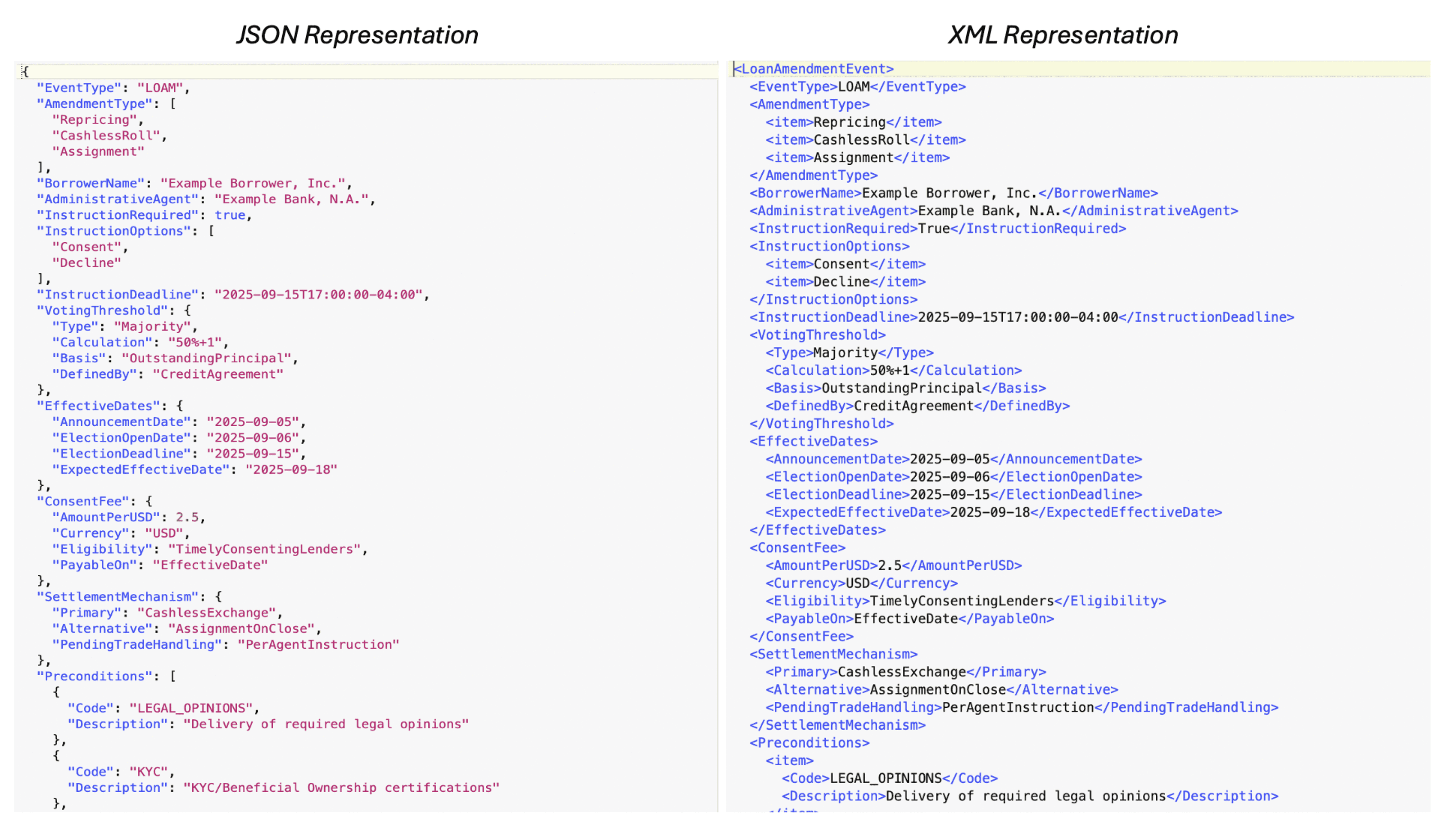
Example structured message representation (illustrative).
Collaborative Industry Approach
To move from concept to practical implementation, a collaborative industry approach can provide a realistic and low-friction path forward.
A working group of buy-side firms could collaborate to:
Contribute representative amendment scenarios reflecting real-world workflows.
Validate a common set of structured data fields and event definitions.
Demonstrate how these can be orchestrated into consistent ISO-aligned workflows.
Provide feedback on usability, integration and operational impact.
Such an approach enables participants to explore structured messaging in a controlled, practical setting, without requiring immediate changes to existing vendor platforms or infrastructure.
Potential Benefits of a Collaborative Approach
Shared insight: Collective validation of common data structures and workflow patterns
Proof of concept: Tangible examples of structured amendment events and end-to-end workflows
Reduced duplication: Avoidance of multiple firms independently solving the same problem
Market alignment: A foundation for broader industry discussion and potential standardisation
Why This Matters
Vendor platforms have shown limited progress in opening up or standardising their outputs. By collaborating, buy-side firms can accelerate the development of a neutral orchestration layer that benefits all participants, reduces operational overhead, and creates constructive pressure for vendors to support open, standards-aligned message formats. A shared proof-of-concept allows firms to validate the approach collectively without committing to long-term licensing or platform migration.
Call to Action: Industry Participation Can Drive This Forward
If you're involved in loan operations, technology, or investment decision-making, there are several ways to support the evolution of more structured workflows:
Engage in industry discussions around standardisation of loan amendment events
Encourage service providers and agents to consider more structured, machine-readable outputs
Explore internal approaches to structuring and normalising amendment data
Share perspectives on operational challenges and potential solutions
Progress in this area will depend on coordinated engagement across the ecosystem, with input from buy-side firms, agents, and technology providers.
Summary
Syndicated loan amendment activity is increasing in both volume and complexity, placing greater pressure on operational teams and exposing the limitations of existing, document-driven workflows.
At the same time, broader market developments - including the growth of private credit, increasing regulatory expectations, and the push toward interoperable API-driven operating models - are accelerating the need for more structured and scalable approaches to event processing.
The analysis in this paper demonstrates that, despite legal and structural variation, loan amendments share a consistent set of operational characteristics. This creates a clear opportunity to define a common data model and move toward standardised, machine-readable event messaging.
Practical implementations of orchestration approaches show that it is already possible to structure and normalise today's unstructured communications, providing a bridge between current workflows and a future state aligned with ISO 20022 principles.
The market is therefore at an inflection point: the tools and understanding now exist to move beyond fragmented, manual processes and toward a more efficient, transparent, and scalable model for managing loan amendment events.
Conclusion
Loan amendments are a routine but operationally complex feature of syndicated lending. Despite their importance, the workflows that support them remain heavily reliant on unstructured communications and manual processes.
The findings outlined here highlight the underlying consistency in how amendment events are structured and executed. This creates a clear opportunity to define a common data model and move toward more standardised, interoperable workflows.
Orchestration approaches illustrate how existing processes can be structured and automated without requiring wholesale system replacement, offering a practical bridge between current market practices and a more scalable future aligned with ISO 20022 principles.
The opportunity now is for the market to build on these foundations - moving from fragmented, document-driven processes toward a more structured, transparent, and efficient operating model.
What do you think?
If you'd like to discuss this insight or share an alternative perspective, we'd be delighted to hear from you.