The Last Interpretation: A Point of View on Market Events
Market Insights
David Baxter






Business Validation and the future of Structured Business Events
Paper available to download here
Introduction
Every day, notices describing shareholder meetings, corporate actions, loan amendments and other market events are published by issuers or, more commonly, on their behalf by registrars, issuer agents and other market service providers.
Each notice enters its respective market ecosystem, and from that point on, market participants - including infrastructure providers, data vendors, custodians, investment banks and others - independently derive operational understanding from that notice, each seeking to answer the same fundamental question:
"What is the issuer's intent?"
For decades, this has been the accepted operating model. Around it, the industry has developed an ecosystem of specialist organisations, operational expertise and supporting technologies whose role is to transform that understanding into machine-readable form. This process takes place across the market, resulting in numerous independent interpretations of the same issuer communication.
Those interpretations then flow downstream to market participants where they are either processed manually or ingested into technologies designed to capture, consolidate, cleanse, enrich and reconcile information. The result is what many organisations refer to as the "golden record" - their trusted operational interpretation of issuer intent.
Whilst this operating model has delivered improvements in automation and operational efficiency, it has done so at significant and recurring cost.
The industry has not ignored the possibility of moving machine-readable information closer to the issuer. Numerous initiatives have sought to achieve precisely that. However, engagement has generally remained limited because responsibility for creating structured information - and the associated operational and technical burden - was placed upon the issuing organisation. Consequently, innovation has continued to focus on improving how issuer intent can be determined after publication, increasingly through artificial intelligence and consensus-based approaches.
This paper does not question the effectiveness of those innovations. Rather, it questions the architectural norm from which they begin and rather than asking the question:
How can we improve interpretation after publication?
This paper asks another:
Why does issuer intent need to be interpreted after publication at all?
1. The Accepted Architecture
Where does issuer intent first become machine-readable?
Today's operating model did not emerge through deliberate design. Rather, it evolved over many decades in response to the practical realities of capital markets.
Issuers communicate primarily through documents intended for human consumption. Whether distributed directly or on their behalf by registrars, issuer agents and other market service providers, those documents remain the authoritative expression of issuer intent.
The challenge begins once those documents enter the market.
Before technology can automate operational processes, the business intent contained within those documents must first be transformed into machine-readable information. Traditionally, this responsibility has fallen to specialist organisations whose role is to collect issuer communications, interpret their meaning and record that understanding within proprietary databases. It is this process that creates the first machine-readable interpretation of issuer intent, from which structured messages and downstream information services can subsequently be generated.
For many participants, however, this represents only the first stage.
At the second stage, structured information received from multiple providers is ingested into technologies that cleanse, enrich, reconcile and consolidate those inputs to create a trusted operational view. These capabilities support automation, exception management, workflow orchestration and the increasingly complex operational processes upon which modern capital markets depend.
Although these two stages perform different functions, they share one important characteristic.
Both occur after publication.
The first creates the initial machine-readable interpretation of issuer intent.
The second seeks to improve confidence in those interpretations.
Together, they form the foundation of today's post-publication operating model.
The effectiveness of this architecture is beyond question. It has enabled successive generations of automation, improved operational efficiency and supported increasingly sophisticated downstream processing across global markets.
The industry has long recognised the benefits of creating structured information closer to the issuer. Initiatives ranging from structured reporting standards and issuer templates to XBRL have all sought, in different ways, to address the challenge at source.
Their common challenge, however, was that responsibility for creating the machine-readable notice remained with the issuer, together with the associated operational cost and technical complexity.
Consequently, the dominant operating model has remained largely unchanged. The first trusted machine-readable interpretation of issuer intent continues to be created after publication, where successive generations of technology have sought to improve its quality, confidence and operational usefulness.
The question, therefore, is not whether the industry recognised this limitation. It did. The question is why every attempt to address it has struggled.
2. We've Been Here Before
The industry has recognised the problem before.
The challenge described in the previous chapter is not new.
The industry has, for many years, recognised that relying on unstructured issuer communications creates operational complexity, duplication and cost. Numerous initiatives have sought to move structured information closer to its source, each reflecting the technologies and regulatory priorities of its time.
Some focused on standardising issuer disclosures. Others introduced structured reporting frameworks or electronic templates.
But these initiatives placed the burden solely on the shoulders of the issuing organisation, requiring additional operational expertise, technical capability and the associated costs to be borne by the issuer.
Five years ago, the European Commission introduced the revised Shareholder Rights Directive (SRD II), requiring shareholder meeting information to be communicated using ISO 20022 messages. The initiative represented perhaps the closest the industry has come to mandating structured information at source and, if successful, could have provided a blueprint for other event types.
The Commission's subsequent review of implementation this year reflects a recognition that, whilst progress has undoubtedly been made, practical challenges remain.
Whilst these initiatives recognised the value of structured information at source, they also shared a common challenge. Responsibility for authoring, maintaining and understanding that structured information remained with the issuer.
The issuer's question was therefore entirely reasonable.
"What's in it for me?"
Without a compelling value proposition for issuers, engagement remained limited.
Consequently, the industry's centre of gravity remained firmly downstream. Rather than changing how issuer communications entered the market, innovation continued along the existing post-publication architecture. Successive generations of technology sought to improve the interpretation of issuer communications after publication. Specialist operational expertise gave way to increasingly sophisticated data platforms. Distributed ledger initiatives explored consensus by comparing independent interpretations submitted by multiple participants. More recently, artificial intelligence has enabled issuer communications to be interpreted directly by large language models, with multiple models increasingly orchestrated to improve confidence through consensus. Each generation has sought to improve efficiency, consistency and automation.
Yet the starting point has remained unchanged. The issuer communication has already entered the market.
That observation is not intended as a criticism. It reflects the reality of today's market architecture. The question, however, is whether technology now allows us to think differently.
The industry has repeatedly asked:
"How do we persuade issuing organisations to create structured information?"
Perhaps that has been the wrong question. The better question may be:
"How do we enable issuing organisations to validate a structured representation of their intent before publication?"
3. The Missing Piece
What if we've been asking the wrong question?
The previous chapters have shown that today's operating model did not arise by accident. It evolved to solve a genuine problem and, in doing so, has enabled successive generations of automation, operational expertise and technological innovation.
They have also shown that the industry has pursued two complementary lines of thinking. The first sought to move structured information closer to the issuer, recognising that the earlier issuer intent became machine-readable, the greater the potential benefit across the market. The second accepted that issuer communications would continue to enter the market in unstructured form and instead focused on improving the speed, quality and confidence of post-publication interpretation.
Both approaches recognised the same objective: a trusted machine-readable representation of issuer intent. The difference lay not in the destination, but in how that destination would be reached. One asked issuing organisations to create structured information. The other accepted that the market would continue to create it.
Technology now allows us to consider another possibility.
What if the structured representation of issuer intent could be automatically created on behalf of the issuing organisation before publication?
That would be a significant step forward. Yet it represents only half the solution, because it immediately raises the next question.
If technology creates the structured representation, how can the issuing organisation - and ultimately the market - have confidence that it accurately reflects the intended business outcome?
That's a different challenge altogether.
4. Business Validation
Trusting the business outcome, not the structured message.
The previous chapter concluded that technology may now be capable of creating a structured representation of issuer intent before publication, without requiring issuers to author structured information themselves.
If that proposition is accepted, an obvious question follows.
How can confidence be established that the structured representation accurately reflects the issuer's intended business outcome?
Historically, confidence has been established after publication. Multiple organisations independently interpret the same issuer communication before comparing, cleansing and reconciling their respective interpretations to arrive at a trusted operational view. More recently, artificial intelligence has sought to improve that process by comparing the outputs of multiple models, each attempting to derive the same business intent from the same source material.
The objective is entirely logical. If multiple independent interpretations arrive at the same conclusion, confidence naturally increases.
Whilst consensus answers one question well:
Was the same conclusion reached?
It fails to answer the one that matters most:
Was that the conclusion the issuer intended?
The distinction is subtle, but fundamental. Consensus measures agreement between interpretations. Business Validation measures agreement with intent. The implications of this shift are illustrated in Figure 1.
Only one organisation can ultimately determine whether the intended business outcome has been correctly understood.
The organisation creating the event.
Importantly, this is not about asking issuers to validate XML, ISO 20022 messages or any other technical representation. Nor does it require them to understand structured messaging standards or the underlying technology. Instead, it asks them to validate something they already understand: the business event itself.
Do the election options accurately reflect the choices being offered?
Are the entitlement calculations correct?
Are the dates, deadlines and conditions those that were intended?
Would a shareholder, lender or other market participant experience exactly the outcome the issuer expects?
These are business questions, not technical ones. They are best answered by the organisation that understands the intended outcome of the event.
If those business outcomes are confirmed, confidence in the structured representation follows naturally.
This changes where trust is established.
Today, the market receives an unstructured communication and expends considerable effort creating the first trusted interpretation of issuer intent. Under the architecture proposed in this paper, the market instead receives a structured interpretation that has already been validated by the issuer against the business outcomes it is intended to produce.
The structured representation itself is not the innovation.
The innovation is that, before publication, the issuer has confirmed that the business outcomes generated from that representation accurately reflect the event they intend the market to process.
Confidence is therefore established not through downstream consensus, but through upstream Business Validation.
Downstream participants are no longer responsible for creating the first trusted interpretation of issuer intent. Instead, they receive an issuer-validated interpretation that can be enriched, operationalised and, where appropriate, subjected to their own controls and business-specific validations.
The role of the market therefore changes.
Rather than repeatedly recreating issuer intent, market participants can increasingly focus on consuming, enriching and operationalising an interpretation whose intended business outcome has already been confirmed at source.
The industry has spent decades improving how issuer intent is interpreted. Business Validation asks a different question:
What if the first trusted interpretation was also the last?
5. A New Architecture
Moving trust to the point of publication.
The preceding chapters have argued that Business Validation changes where trust is first established. Rather than being created progressively through downstream interpretation and consensus, confidence in issuer intent can be established before the event enters the market.
This changes the architecture.
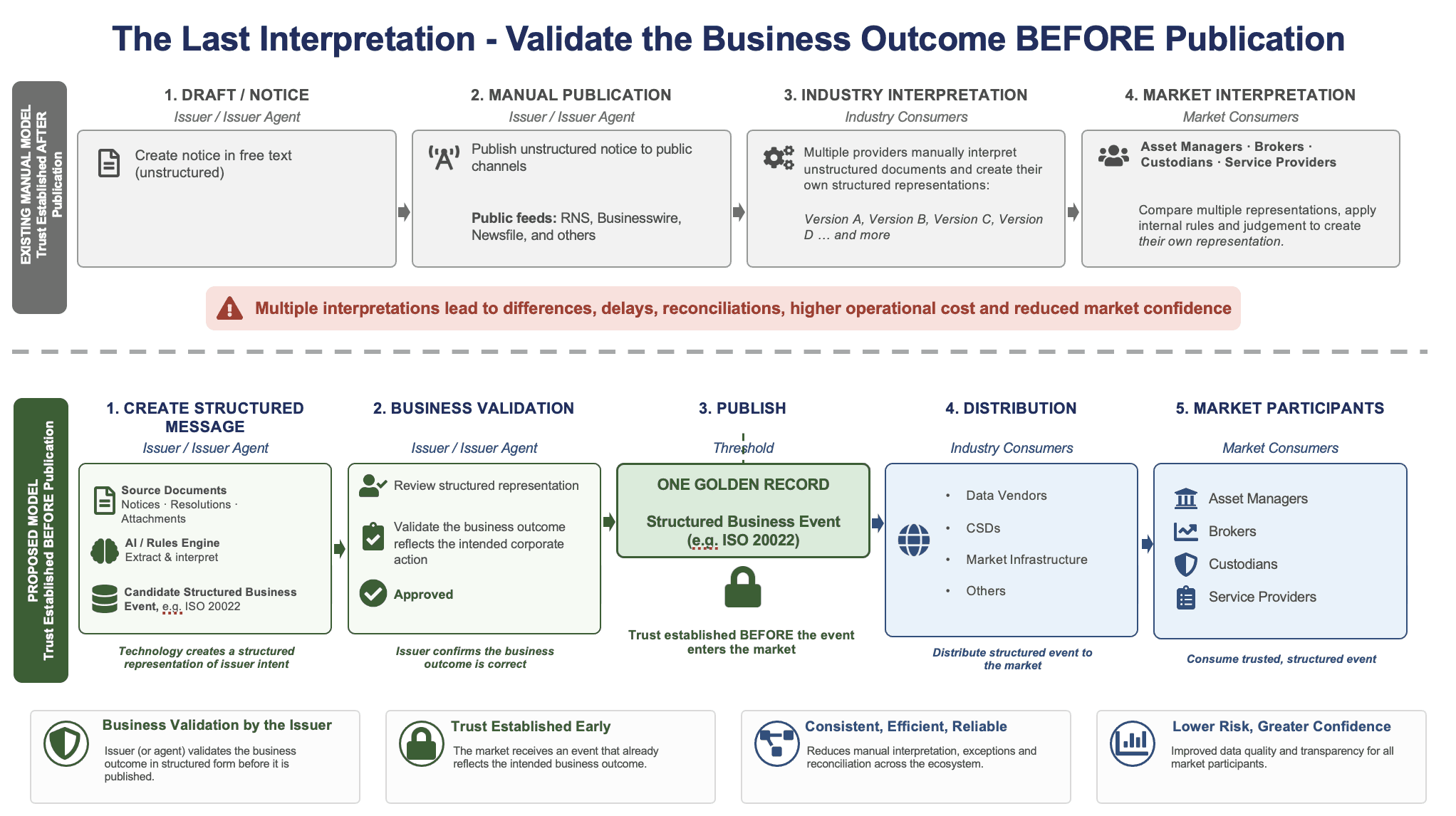
Figure 1. From multiple interpretations to the issuer-validated Structured Business Event - The Golden Record
Under today's operating model, an issuer communication is published in unstructured form before being interpreted, transformed into structured information and progressively refined through enrichment, reconciliation and consensus. Every organisation that first works from that communication must first determine its operational meaning before automation can take place.
Under the proposed architecture, the issuer continues to publish the same business event. The difference is that, before publication, technology creates a structured representation of that event, and the issuer validates that the business outcomes it produces accurately reflect issuer intent. The market therefore receives not simply an unstructured notice, but an issuer-validated Structured Business Event.
The distinction may appear modest. Its consequences are not.
The first trusted interpretation of issuer intent no longer has to be created by the market. It enters the market already validated by the organisation best placed to confirm the intended business outcome.
This does not remove the need for downstream processing, nor does it diminish the role of existing market participants. Data vendors and market infrastructure providers will continue to distribute information. Custodians will continue to apply client-specific processing rules. Investment managers will continue to make investment decisions. Technology providers will continue to automate increasingly sophisticated operational workflows.
Nor does it require the market to change overnight. As with any new capability, adoption would naturally be incremental. Structured Business Events would coexist alongside today's operating model, allowing issuers, registrars and market participants to adopt the architecture at their own pace without disrupting established workflows.
What changes is the starting point.
Rather than independently recreating issuer intent, downstream participants begin from the same issuer-validated understanding of the event. Their effort is therefore directed towards activities that genuinely differentiate their businesses, rather than repeatedly performing the same initial interpretation.
Nor does this architecture eliminate the need for validation within individual organisations. Participants will always apply their own business rules, proprietary data, regulatory obligations and operational controls. Those validations remain an essential part of the processing lifecycle.
What changes is the point at which confidence in issuer intent is first established.
Instead of relying upon multiple organisations to derive and compare independent interpretations after publication, the market begins with an interpretation whose intended business outcome has already been confirmed by the organisation creating the event.
Expertise is not removed from the process. It is applied where it carries the greatest authority.
Technology is not replacing operational knowledge. It is enabling that knowledge to be confirmed before it propagates through the market.
So, whilst the operational process is the same, it now begins from an issuer-validated understanding of the event.
6. The Economics
Creating value by eliminating unnecessary interpretation.
Every market architecture has an economic consequence.
Today's architecture is no exception. Because issuer intent first becomes machine-readable after publication, every participant in the market invests resources in determining substantially the same thing. Specialist operational teams interpret issuer communications, technology platforms transform those interpretations into structured information, and downstream organisations expend further effort comparing, enriching and validating the resulting outputs.
This investment has created an impressive ecosystem of expertise and technology. It has also enabled markets to automate increasingly complex operational processes.
Much of that investment, however, exists because the first trusted interpretation of issuer intent has yet to be created.
Instead, it is recreated repeatedly across multiple organisations.
Business Validation changes that economic model.
Rather than repeatedly investing in the creation of the first trusted interpretation, the market begins with an issuer-validated understanding of the event. The effort previously devoted to determining issuer intent can increasingly be redirected towards activities that genuinely create value: richer data services, improved client experiences, enhanced analytics, regulatory compliance, operational resilience and new product innovation.
Importantly, this is not an argument for removing expertise from the market.
As discussed in the previous chapter, Business Validation does not diminish the role of existing market participants. Operational expertise remains essential. What changes is not who performs the work, but where the real value is created.
Instead of repeatedly answering the question "What does the issuer intend?", organisations are free to focus on the activities that genuinely differentiate them.
The economic implications are not limited to downstream participants.
Earlier we asked why previous initiatives struggled to gain meaningful issuer engagement. The answer has often been simple.
"What's in it for me?"
Business Validation provides a different answer.
Issuers, or the organisations acting on their behalf, are no longer simply producers of unstructured notices. They become the source of an issuer-validated Structured Business Event, creating something of operational value to the market.
Whether that structured event is provided as part of an existing issuer service, bundled within a registrar's offering or made available through a commercial subscription becomes a business decision rather than a technical limitation.
The objective is not to monetise information that is already public.
It is to recognise the additional value created by delivering that information in a trusted, operationally consumable form.
For registrars, issuer agents and other service providers, this creates the opportunity to extend existing issuer services beyond publication and administration into the provision of validated structured business events. Rather than simply supporting the publication process, they become the trusted source from which the market consumes operationally ready information.
The benefits therefore extend across the entire ecosystem.
Issuers gain confidence that the market is processing the event they intended.
Registrars and issuer agents gain the opportunity to deliver new value-added services to their clients.
Market infrastructure providers, data vendors, custodians and technology providers begin from the same issuer-validated understanding. Their expertise becomes less about repeatedly establishing issuer intent and more about enriching, operationalising and creating value from information whose intended business outcome has already been confirmed.
The industry's investment therefore shifts. Less effort is spent determining issuer intent. More effort is spent creating value from it. This is more than an operational improvement.
It is a redistribution of where value is created within the capital markets ecosystem.
7. Demonstrating Feasibility
From concept to capability.
The concepts described throughout this paper are not purely theoretical. They are informed by work undertaken as part of the iActs® programme, where many of the architectural principles described have already been demonstrated across market-event workflows.
Previous initiatives recognised the value of structured information at source. Their challenge was not a lack of vision, but the practical reality that issuers and their appointed agents were expected to create and maintain that structured information themselves. The tools required to make that practical simply did not exist, leaving issuers to bear the cost, operational burden and technical complexity of authoring machine-readable information.
The architectural approach described in this paper seeks to address that gap. Rather than asking issuers to become specialists in structured messaging, technology derives a structured representation of an issuer's existing notice before publication and presents the resulting business outcomes for validation by the organisation creating the event. Issuers continue to communicate in the manner they do today; what changes is that, for the first time, they are able to distribute the same notice as a Structured Business Event, knowing that the structured representation faithfully reflects their intended business outcome.
This additional capability has the potential to reduce the repeated cost of interpretation across the market, minimise operational risk arising from inconsistent interpretations, accelerate the availability of trusted structured information and support regulatory initiatives that increasingly seek earlier, more consistent and interoperable market data.
It also changes the proposition for issuers and their appointed agents. Rather than representing an additional operational burden, issuer-validated Structured Business Events have the potential to become a value-added service in their own right. Registrars, issuer agents and other market service providers may therefore find that the same capability which improves market efficiency also creates opportunities to differentiate their services and, where appropriate, establish new commercial models around the provision of trusted structured business events.
Whether the concepts described in this paper are ultimately realised through iActs® or another implementation is, in many respects, secondary. The more significant point is that Business Validation is no longer simply a theoretical proposition.
It is now a practical possibility.
Conclusion
The Last Interpretation
For decades, capital markets have accepted that issuer intent enters the market as an unstructured communication and only becomes machine-readable as organisations independently interpret and structure that information after publication.
Around that operating model, an extraordinary ecosystem of operational expertise, technology and market infrastructure has evolved. This paper does not argue that architecture is wrong. Instead, it proposes that technology now allows us to question one of the assumptions upon which it was built.
Rather than asking issuers to author structured information, let technology create it, and let issuers, or the organisations acting on their behalf, validate the intended business outcome prior to publication.
If confidence in issuer intent can be established at that point, the market no longer needs to repeatedly create the first trusted interpretation of every event. Instead, it can begin from an issuer-validated understanding and focus its effort where it creates the greatest value.
Perhaps that is the real opportunity.
Not to build ever better ways of interpreting issuer communications.
But to ask whether the first trusted interpretation of issuer intent should also be the last.
What do you think?
If you'd like to discuss this insight or share an alternative perspective, we'd be delighted to hear from you.